 howMed Know Yourself
HISTORY
Albrecht Kossel (1853-1927), German physiologist and Nobel laureate
Nucleic acids consist of nitrogen-bearing compounds known as purines and pyrimidines.
Nitrogen-containing bases are cytosine, thymine, adenine, and guanine
Nomenclature
Nucleotides are composed of:
v Nitrogenous base
v Pentose sugar
v Phosphate groups
Nitrogenous Bases
• Aromatic and heterocyclic
• Derived from purine or pyrimidine
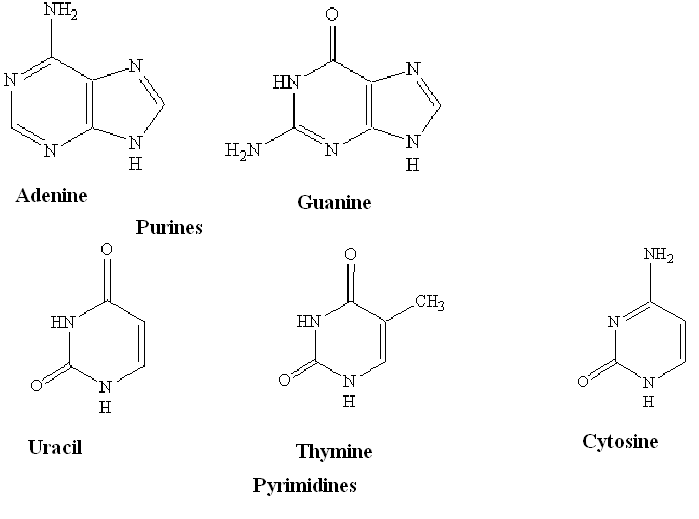
Important Purines
Adenine and guanine are the principal purines of both DNA and RNA. Double cyclic ring
Important Pyrimidines
Pyrimidines that occur in DNA are cytosine and thymine. Cytosine and uracil are the pyrimidines in RNA. Single cyclic
-
Biochemical Role of Nucleotide Derivatives
DNA and RNA Synthesis dNTP, NTP
- Protein Synthesis ATP, GTP
- Citric acid cycle GTP/GDP
- Part of Membrane Receptor GTP
- Synthesis of Glycerophospholipid CTP/CDP
- Glycogen Synthesis UDP-glucose
- Oxidative Phosphorylation ADP/ATP
- Signal Transduction cAMP cGMP
- Muscle Contraction ATP
- Electrolyte Balance ATP
- Coenzymes NAD FAD CoA
- Allosteric regulators ATP, AMP …
Sugar
• Pentoses (5-C sugars)
• Numbering of sugars is “primed”.
Phosphate Groups
• Mono-, di- or triphosphates
• Phosphates can be bonded to either C2, C3 or C5 atoms of the sugar
Nucleosides
• Result from linking one of the sugars with a purine or pyrimidine base through an N-glycosidic linkage
– Purines bond to the C1’ carbon of the sugar at their N9 atoms
– Pyrimidines bond to the C1’ carbon of the sugar at their N1 atoms
Nucleotides
Result from linking one or more phosphates with a nucleoside onto the 5’ end of the molecule
PHOSPHATE LINKAGE
5’ Phosphate
3’ Phosphate
2’ Phosphate
Naming Conventions
• Nucleosides:
– Purine nucleosides end in “-sine”
• Adenosine, Guanosine
– Pyrimidine nucleosides end in “-dine”
• Thymidine, Cytidine, Uridine
• Nucleotides:
– Start with the nucleoside name from above and add “mono-”, “di-”, or “triphosphate”
• Adenosine Monophosphate, Cytidine Triphosphate, Deoxythymidine Diphosphate
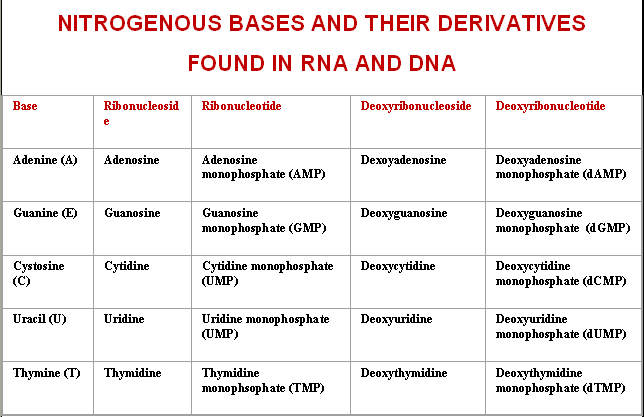
• RNA (ribonucleic acid) is a polymer of ribonucleotides
• DNA (deoxyribonucleic acid) is a polymer of deoxyribonucleotides
• Both deoxy- and ribonucleotides contain Adenine, Guanine and Cytosine
– Ribonucleotides contain Uracil
– Deoxyribonucleotides contain Thymine
TYPES OF NUCLIEC ACID
• DEOXY RIBONUCLEIC ACID – DNA
• RIBO NUCLEIC ACID – RNA
– mRNA
– tRNA
– rRNA
DNA structure
• B-DNA, A-DNA , Z-DNA forms
• B-DNA is most common
• Antiparallel
• stands complementary
– Very important for information transfer
– Each strand a template for the other.
• right handed
• major and minor groove
One Strand of DNA
• The backbone of the molecule is alternating phosphates and deoxyribose sugar
• The teeth are nitrogenous bases.
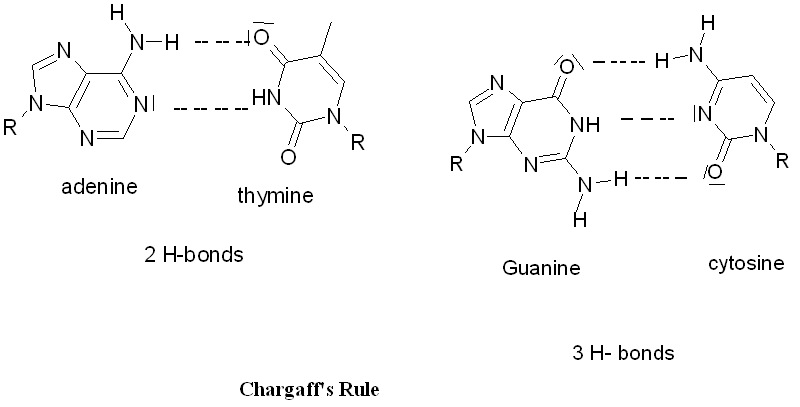
Chargraff’s Rule:
• Adenine and Thymine always join together
• Cytosine and Guanine always join together
RNA
• codes for protein
• single stranded
• Ribose instead of deoxyribose
• Thymine (T) replaced by Uracil
1. Nucleotides are constantly
undergoing turnover!
2. There are many enzymes involved;
Nucleotidases
Nucleoside phosphorylases
Deaminases
Xanthine oxidases
Purine Degradation
• Purine Nucleotides from ingested nucleic acids or turnover of cellular nucleic acids is excreted by humans as uric acid.
• Humans excrete about 0.6 g uric acid every 24 hours.
Pyrimidine Degradation
• Pyrimidines are generally degraded to intermediates of carbon metabolism (for example, succinyl-CoA) and ammonia (NH4+).
• NH4+ is packaged as urea through
the urea cycle and excreted by humans
• Defects in enzymes of pyrimidine degradation have
been documented, resulting in increased levels of pyrimidines and neurological disorders.
Functions of nucleic acids
• DNA is a basis of heredity
• DNA is carrier of genetic information
• DNA contains genes, the information needed to synthesize functional proteins and RNAs
• DNA contains segments that play a role in regulation of gene expression
• Ribosomal RNAs (rRNAs) are components of ribosomes, playing a role in protein synthesis
• Messenger RNAs (mRNAs) carry genetic information from a gene to the ribosome
• Transfer RNAs (tRNAs) translate information in mRNA into an amino acid sequence